

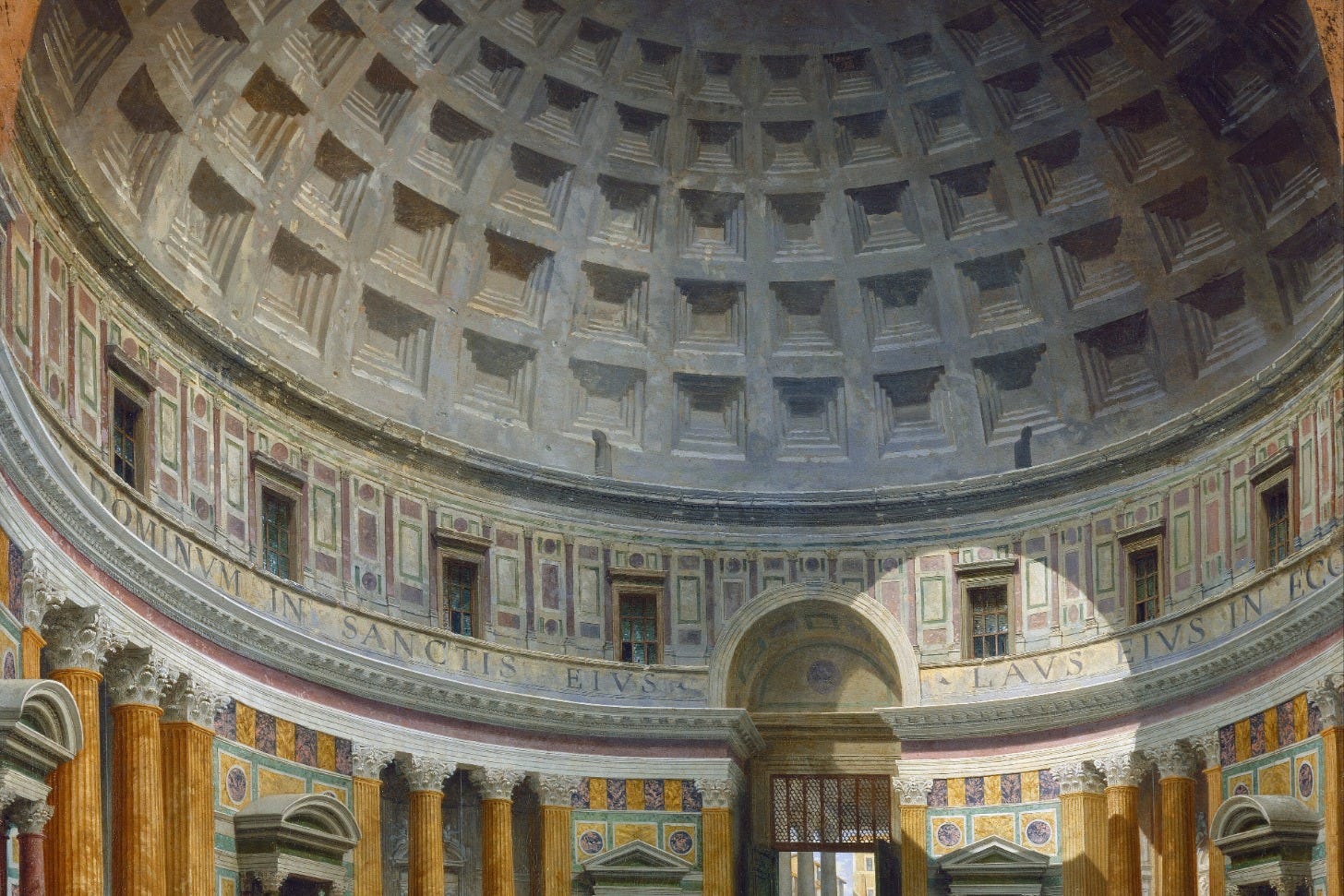
Interior of the Pantheon | Giovanni Paolo Panini, ca. 1734 (detail)
Why would a Roman rank an aqueduct above the Pyramids?
Key Terms for this Lesson
Concrete · Aqueduct · Pantheon
Art for the State | Portraits, Arches, & Concrete
Roman art served the state, and so did its buildings. Roman sculpture of the Republican period featured realistic details, wrinkles and all, that expressed the inner character of the sculpted figure. Romans also loved Greek art, and much of what we know of Greek sculpture survives only in Roman marble copies, Myron’s Discus Thrower among them (cf. Sec. 7.2). The most famous statue of Augustus, the Augustus of Prima Porta, shows him in armor with his arm raised, about to give a speech, not wield a sword. His breastplate celebrates a victory of diplomacy, the return of Rome’s lost battle standards from the Parthians (20 BCE). At his feet, Cupid rides a dolphin, a reminder that the Julian family traced its line to Venus (cf. Sec. 8.3).
Much of what we know of Roman houses and their painted walls comes from Pompeii. Pompeii was a prosperous town on the Bay of Naples, and the eruption of Mount Vesuvius in 79 CE buried it in ash, preserving its streets, shops, kitchens, and household shrines (cf. Sec. 8.2) for archaeologists to uncover seventeen centuries later. The naturalist Pliny the Elder died in the eruption, and his nephew, Pliny the Younger, described it in two letters to the historian Tacitus.
Public buildings were constructed to show the glory of their builders, much as the pyramids of Egypt had been (cf. Sec. 3.4). The Romans did not invent the arch. Mesopotamia and the Etruscans had built them. Rome’s contribution was to build arches, and the vaults and domes that grow from them, on a scale no one had attempted. A Greek temple stood on posts and beams (cf. Sec. 7.2). A Roman arch carries its weight down and outward through a curve of wedge-shaped stones, so it can span a river or hold up a stadium. Generals and emperors also raised freestanding triumphal arches to celebrate their victories.
The material that made the scale possible was Roman concrete. Builders mixed lime with a volcanic ash from the Bay of Naples, called pozzolana, and rubble. The engineer Vitruvius (d. after 15 BCE) marveled that it hardens even under the sea (On Architecture 2.6). Concrete could be shaped into almost any form, and Roman concrete has outlasted the empire by fifteen centuries.
Aqueducts | Water for a City of a Million
• 312 BCE | The Aqua Appia, Rome’s first aqueduct
• ca. 40–60 CE | The Pont du Gard carries water to Nîmes
• 97 CE | Frontinus becomes Rome’s water commissioner
• 226 CE | The Aqua Alexandrina, the last of Rome’s eleven aqueducts
An aqueduct is a channel that carries water to a city by gravity alone. Rome’s first, the Aqua Appia, was built in 312 BCE by the censor Appius Claudius, who also built the Appian Way. Most of an aqueduct ran underground, sloping gently for dozens of miles. Only where it crossed a valley did it rise on the famous arches. By the 200s CE, eleven aqueducts brought fresh water to perhaps a million people, feeding public fountains, baths, and a great covered sewer (the Cloaca Maxima). To deal with the crowded city, Rome built the infrastructure that kept it alive.
The aqueducts reached every corner of the empire. In southern Gaul (~France), the Pont du Gard carried the aqueduct of Nemausus (Nîmes), which ran about 31 miles (50 km), across the river Gardon on three tiers of arches 160 feet (49 m) high, built without mortar in their stone blocks. The man in charge of Rome’s water around 97 CE, Frontinus, made the Roman case plainly:
With such an array of indispensable structures carrying so many waters, compare, if you will, the idle Pyramids or the useless, though famous, works of the Greeks! The Aqueducts of Rome (1.16, trans. Charles E. Bennett)
The Pantheon | A Temple for All the Gods
The arch, turned in a full circle, becomes a dome, and the greatest Roman dome still stands. The Pantheon was begun under Trajan (ca. 114 CE) and finished under the emperor Hadrian (ca. 125 CE), on the site of an earlier temple built by Augustus’ general Agrippa. Hadrian (d. 138 CE) kept Agrippa’s name in the inscription over the porch, so the building still credits a man dead for more than a century. Its name means a temple of “all the gods” (Gr. pan + theos).
What was significant about the Pantheon’s huge concrete roof was the oculus (Latin for “eye”), a round opening at the top that lets light into the building. The dome is 142 feet (43 m) across, exactly as high as the floor is wide, so a perfect sphere would fit inside. Its builders made the concrete lighter as it rose, with pumice near the top, and cut sunken panels (coffers) into the ceiling to lighten it further. After nineteen centuries, it is still the largest dome of unreinforced concrete in the world. When it rains, the water falls through the oculus onto a floor built to drain it.
The Pantheon survived because it never stopped being used. In 609 CE, it became a church, and it has been one ever since.
Sec 8 • The Romans
8.1 History & Politics • From Republic to Empire
8.2 Religion • Household Gods & the Imperial Cult
8.3 Literature & Drama • The Aeneid & Roman Satire
8.4 Art & Architecture • Aqueducts & Arches
8.5 Music • The Water Organ & the Arena
8.6 Philosophy • Stoicism & Roman Law
Course Page: Humanities I & II