

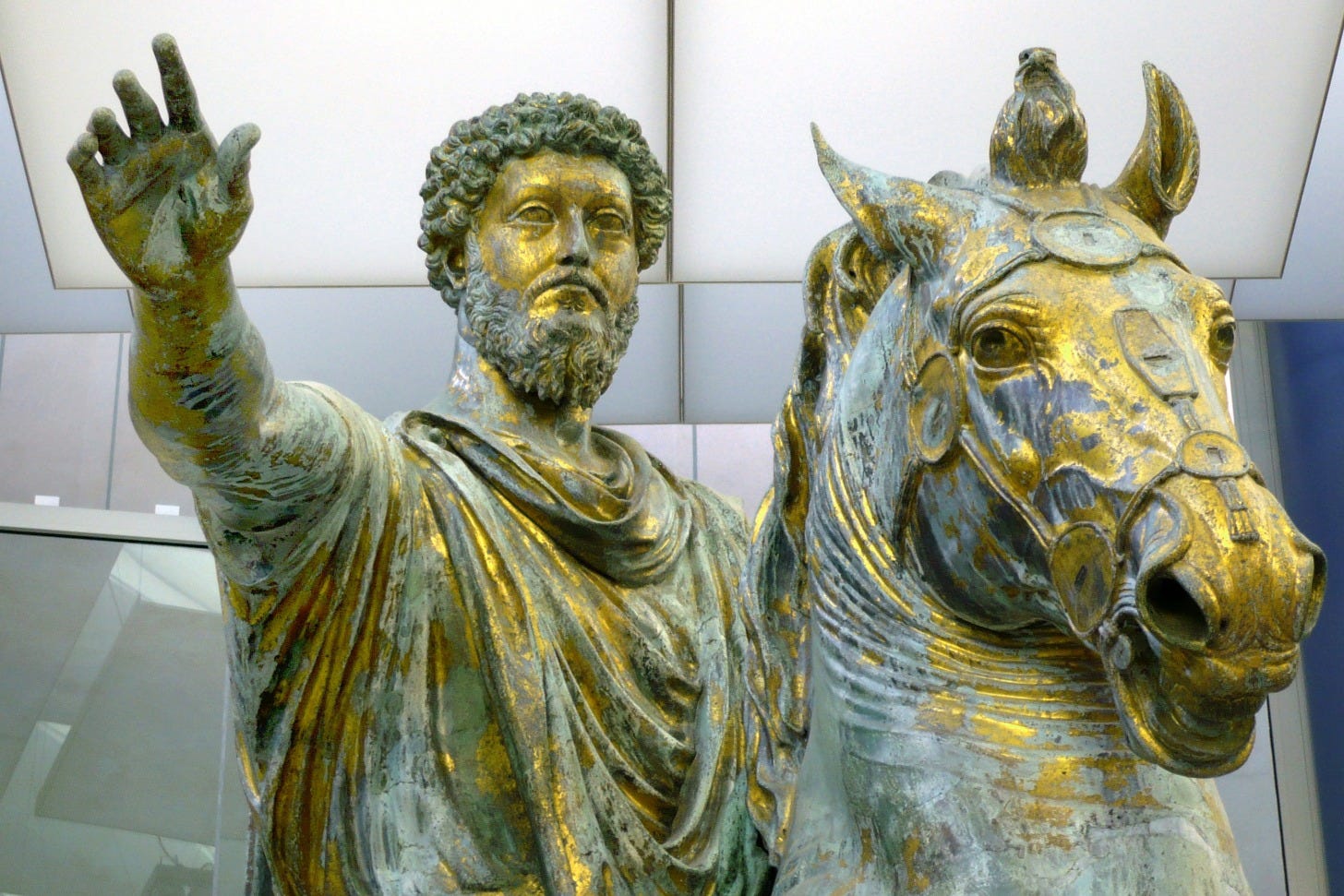
Equestrian Statue of Marcus Aurelius | Rome, ca. 175 CE
Photo Credit: Zanner via Wikimedia Commons
Why did the most powerful man in the world keep a notebook of reminders to stay calm?
Key Terms for this Lesson
Stoicism · Twelve Tables · Ius Gentium
Zeno & the Stoa | Let It Go
Founded by Zeno (d. ca. 262 BCE) in the Hellenistic Period (cf. Sec. 7.1), Stoicism pursues inner peace and psychological resilience through mastery of one’s virtue. Once a wealthy merchant, Zeno lost his cargo in a shipwreck. He later found refuge in philosophy. He shared his insights at the Stoa Poikile (the “Painted Porch,” a colonnade on the agora in Athens), which gave Stoicism its name. This Hellenistic philosophy emphasizes rationality, deference to the logos, and the radical acceptance of one’s fate. The Stoics took the logos of Heraclitus, “the divine ordering principle of the cosmos, reason itself,” and made it the center of their ethics (cf. Sec. 6.5).
The central claim of Stoicism is that while we cannot control external events, we can control how we respond to them. This is the Stoic dichotomy of control. “Of things some are in our power, and others are not,” begins the handbook of the Stoic teacher Epictetus (d. ca. 135 CE), a former slave (Enchiridion 1, trans. George Long). It urges us to focus on our thoughts, actions, and decisions, while accepting that external circumstances (like wealth, status, or physical well-being) lie, for the most part, beyond our influence. Stoics claim that it is not the events themselves that disturb us, but our judgments about them.
The Stoics pursued the Four Cardinal Virtues already named in Plato’s Republic: wisdom, temperance, justice, and courage. For Aristotle, eudaimonia, “flourishing: to live up to one’s best purpose, one’s best self,” also needed some good fortune (cf. Sec. 7.6). For the Stoic, virtue alone was enough. An untroubled mind, much like the ataraxia of Epicurus (cf. Sec. 4.4), was its fruit.
Seneca, Epictetus, & Marcus Aurelius | Stoics in Rome
Some very famous Romans were Stoics. Stoicism was particularly popular among leaders, perhaps because it stressed calm dignity through all events. Seneca (d. 65 CE) was tutor to the young emperor Nero and tried to retire from his service in 62 CE (Tacitus, Annals 14.53–56). Seneca wrote that anger comes from surprise, and surprise from hoping too much. Think of the drivers in town: you get angry with them because you are hopeful that they won’t do the foolish things they do on the road. So the Stoics rehearsed each morning the things that could go wrong. The early Stoics had their own picture for it, a dog tied to a moving cart (Hippolytus, Refutation 1.21). The leash gives the dog some freedom, and a smart dog goes along with the cart. A foolish one fights the leash and is dragged anyway.
Roman Stoicism’s most famous advocate was the emperor Marcus Aurelius (d. 180 CE). His reign included vicious wars, a deadly plague, and deeply personal losses, yet he held fast to Stoic ideals. On campaign, he kept a private notebook of reminders addressed to himself, which we call the Meditations. To this philosopher’s mind, he may be the closest Rome came to the philosopher-king who rules the ideal city of Plato’s Republic (cf. Sec. 7.6). His notes show a man practicing self-command on the hardest job in the world:
Begin the morning by saying to thyself, I shall meet with the busy-body, the ungrateful, arrogant, deceitful, envious, unsocial. … I can neither be injured by any of them, for no one can fix on me what is ugly, nor can I be angry with my kinsman, nor hate him. For we are made for co-operation, like feet, like hands, like eyelids, like the rows of the upper and lower teeth. Meditations (2.1, trans. George Long)
For Aurelius, adversity is an essential part of life. “[T]hat which is an obstacle on the road helps us on this road,” he writes (5.20, Long).
Roman Law | The Twelve Tables to Justinian
Rome’s most lasting philosophy may be its law. In 451–450 BCE, after the plebeians demanded laws they could read (cf. Sec. 8.1), a commission wrote the Twelve Tables, Rome’s first written code, and set them up in the Forum. Like Hammurabi’s code (cf. Sec. 2.6), they put the law where every citizen could see it, and Roman schoolboys learned them by heart. The law of Roman citizens was the ius civile. As Rome came to rule many peoples, its judges developed the ius gentium, the “law of nations,” for cases between Romans and foreigners. Roman thinkers came to explain it in Stoic terms: one reason governs all people, so the same justice should bind them all. Cicero put it plainly: “True law is right reason conformable to nature, universal, unchangeable, eternal… It is not one thing at Rome, and another at Athens; one thing to-day, and another to-morrow” (On the Republic 3.33, trans. Francis Barham, rev. C. D. Yonge).
The emperor Justinian (d. 565 CE) gathered a thousand years of Roman law into one collection, the Corpus Juris Civilis (529–534 CE), issued in Constantinople. Its textbook opens, “Justice is the set and constant purpose which gives to every man his due,” and it defines the law of nations as the rules “prescribed by natural reason for all men” (Institutes 1.1, 1.2.1, trans. J. B. Moyle). Justinian’s collection became the foundation of the civil law that still governs most of Europe and Latin America today.
Sec 8 • The Romans
8.1 History & Politics • From Republic to Empire
8.2 Religion • Household Gods & the Imperial Cult
8.3 Literature & Drama • The Aeneid & Roman Satire
8.4 Art & Architecture • Aqueducts & Arches
8.5 Music • The Water Organ & the Arena
8.6 Philosophy • Stoicism & Roman Law
Course Page: Humanities I & II
Next Section: Ancient Israel