

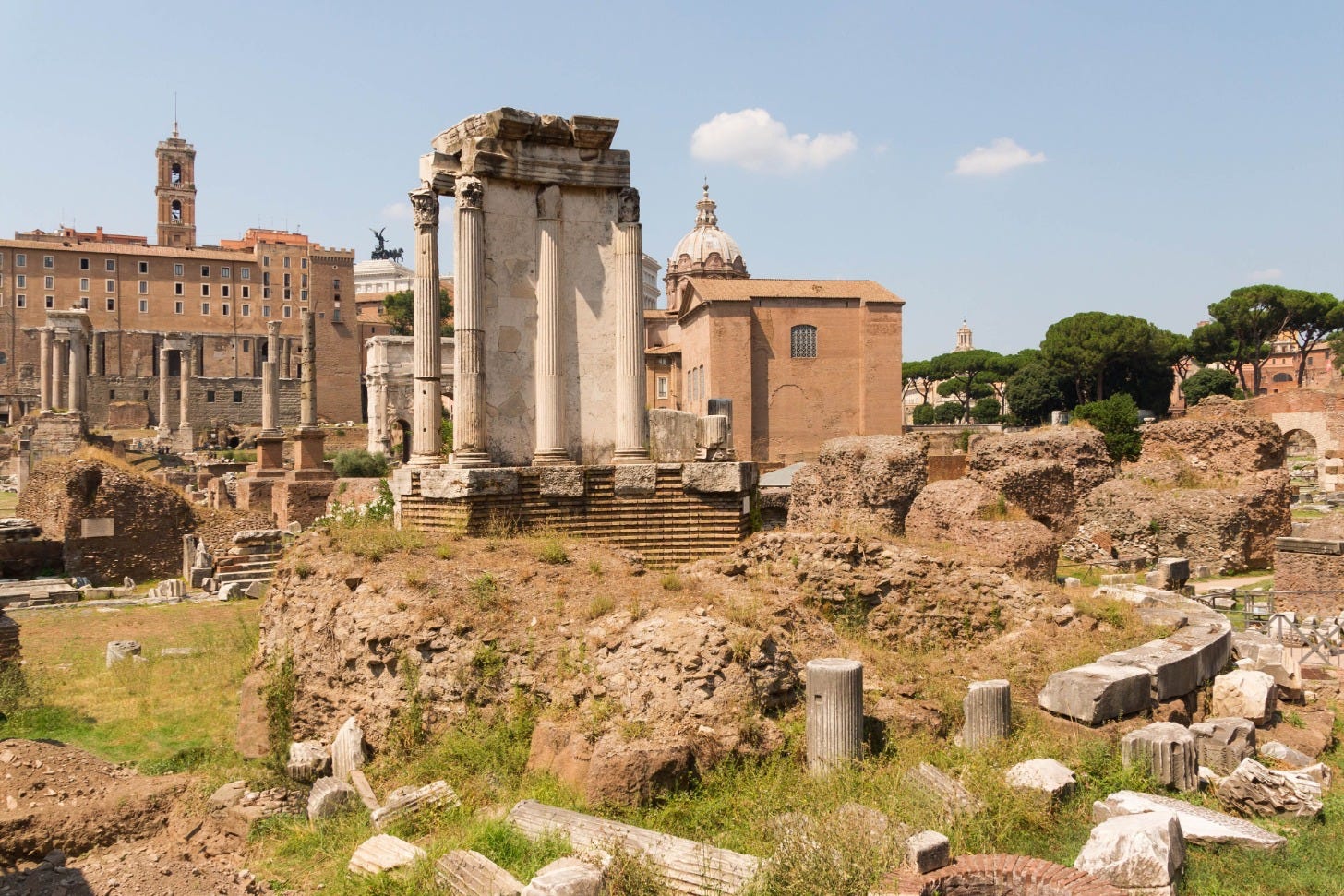
The Temple of Vesta | Roman Forum, Rome
Photo Credit: Jebulon via Wikimedia Commons, CC0
Why did every Roman house keep its own gods?
Key Terms for this Lesson
Mos Maiorum · Lares & Penates · Imperial Cult
Religio | Duty to the Gods & the City
Since Section 2, the religion lesson of each section has been called “Sacred Life,” because before Rome there was no word for religion (cf. Sec. 1.2). The Romans give us the word. In the first century BCE, the statesman and philosopher Cicero (d. 43 BCE) writes of religio, the careful observance of everything a Roman owed the gods. Cicero traced the word to relegere, “to go over again”:
…they who diligently perused, and, as we may say, read or practised over again, all the duties relating to the worship of the Gods, were called religiosi—religious, from relegendo… On the Nature of the Gods (2.72, trans. rev. C. D. Yonge)
More than three centuries later, the Christian writer Lactantius (d. ca. 325 CE) offered a second derivation, from religare, “to bind back.” The scholars still disagree. Either way, religio named a duty, not a private creed.
Central to Roman cultural life was the mos maiorum, the “way of the ancestors.” This term was not written in scripture. Instead, it refers to the values and traditions that each Roman generation inherited from those who came before. It was crucial to remain faithful to these ancestral norms, and to Rome itself, a commitment Romans called fides (Latin for “faithfulness”). We see echoes of this today in the U.S. Marine Corps motto, Semper Fidelis, “Always Faithful.” Rome’s religion was a state affair. Instead of the separation of church and state as we practice it in the United States, Rome’s sacred practices were integral to the government, with an official priesthood, public temples, and a calendar of festivals. Receiving an appointment to be a priest was a noted honor.
The gods’ will was read before every public act. The augurs, a college of priests, watched which way the birds flew before an election, a battle, or a sacrifice, and an unfavorable sign could stop the business of the state. Cicero, himself an augur, called theirs the highest and most important authority in the Republic (On the Laws 2.31). Offerings ranged from grain and incense to domestic animals, which were considered more powerful and were made in thanksgiving, or for forgiveness, at important events. The greater the event, the greater the offering.
The Hearth | Vesta, the Lares, & the Penates
At the same time, Romans practiced a simpler religion at home. It honored Vesta, the goddess of the hearth, and the Lares, minor guardian gods who protected the home and its land. Beside them stood the Penates, the gods of the storeroom, whose name Cicero takes from penus, the household’s store of food (On the Nature of the Gods 2.68). In many houses, a small shrine called a lararium stood in the kitchen or the front hall, often painted with the Lares as young dancers pouring from raised cups. Hundreds survive at Pompeii. Here the head of the family offered the household’s first fruits, grain, incense, and garlands, on festival days and at every turn of family life.
The house was a little city, and the city had a hearth of its own. In the Roman Forum, Vesta’s round temple kept a sacred fire that was never allowed to go out. Six priestesses, the Vestal Virgins, tended it, chosen as girls and serving for thirty years, and they kept the city’s most sacred objects in the temple’s inner store. As long as Vesta’s fire burned, Rome stood.
Ancestors were also esteemed and highly regarded, especially by families with a long and honored history of public service (cf. Sec. 5.2). Such families kept wax masks of their ancestors in the front hall, and at a funeral, men chosen for their likeness to the dead wore them in procession, so that the whole line of the family led its newest member to the Forum.
Gods of the Empire | Isis & the Divine Caesars
The Romans welcomed new gods as readily as new citizens. They had long identified their own gods with the Greek gods, Jupiter with Zeus and Juno with Hera (cf. Sec. 6.3). This fusion of traditions is called syncretism. They also brought foreign gods to Rome outright: the Great Mother, Cybele, from Asia Minor in 204 BCE, and Isis from Egypt (cf. Sec. 3.2). Isis drew devotion across the Roman world (cf. Sec. 7.3), and her temple still stands in Pompeii, where the eruption of Vesuvius buried it in 79 CE. Rome could tolerate almost any god, as long as the gods of Rome received their due.
Rome’s newest gods were its rulers. After the assassination of Julius Caesar in 44 BCE (cf. Sec. 8.1), a comet blazed over his memorial games, and many Romans took it for his soul rising to the heavens. In 42 BCE, the Senate declared him a god of the state, Divus Iulius, “the deified Julius,” and his temple rose in the Forum where his body had been burned. The ancient idea of the god-king had come to Rome (cf. Sec. 2.2, 3.1). Augustus was declared divus after his death in 14 CE, and while he lived, the provinces built altars to “Rome and Augustus.” This was the Imperial Cult: temples, priests, and offerings for the emperors, living and deified, across the empire. In any empire, one must hold power over a people’s economy, military, politics, and ideology (cf. Michael Mann). Ideology is harder. Symbols are difficult to control. A pinch of incense before the emperor’s image was a public act of fides, loyalty to Rome made visible. Jews held an ancient exemption from these sacrifices. Around 112 CE, the governor Pliny the Younger wrote to the emperor Trajan about Christians in his province who refused them.
Sec 8 • The Romans
8.1 History & Politics • From Republic to Empire
8.2 Religion • Household Gods & the Imperial Cult
8.3 Literature & Drama • The Aeneid & Roman Satire
8.4 Art & Architecture • Aqueducts & Arches
8.5 Music • The Water Organ & the Arena
8.6 Philosophy • Stoicism & Roman Law
Course Page: Humanities I & II