

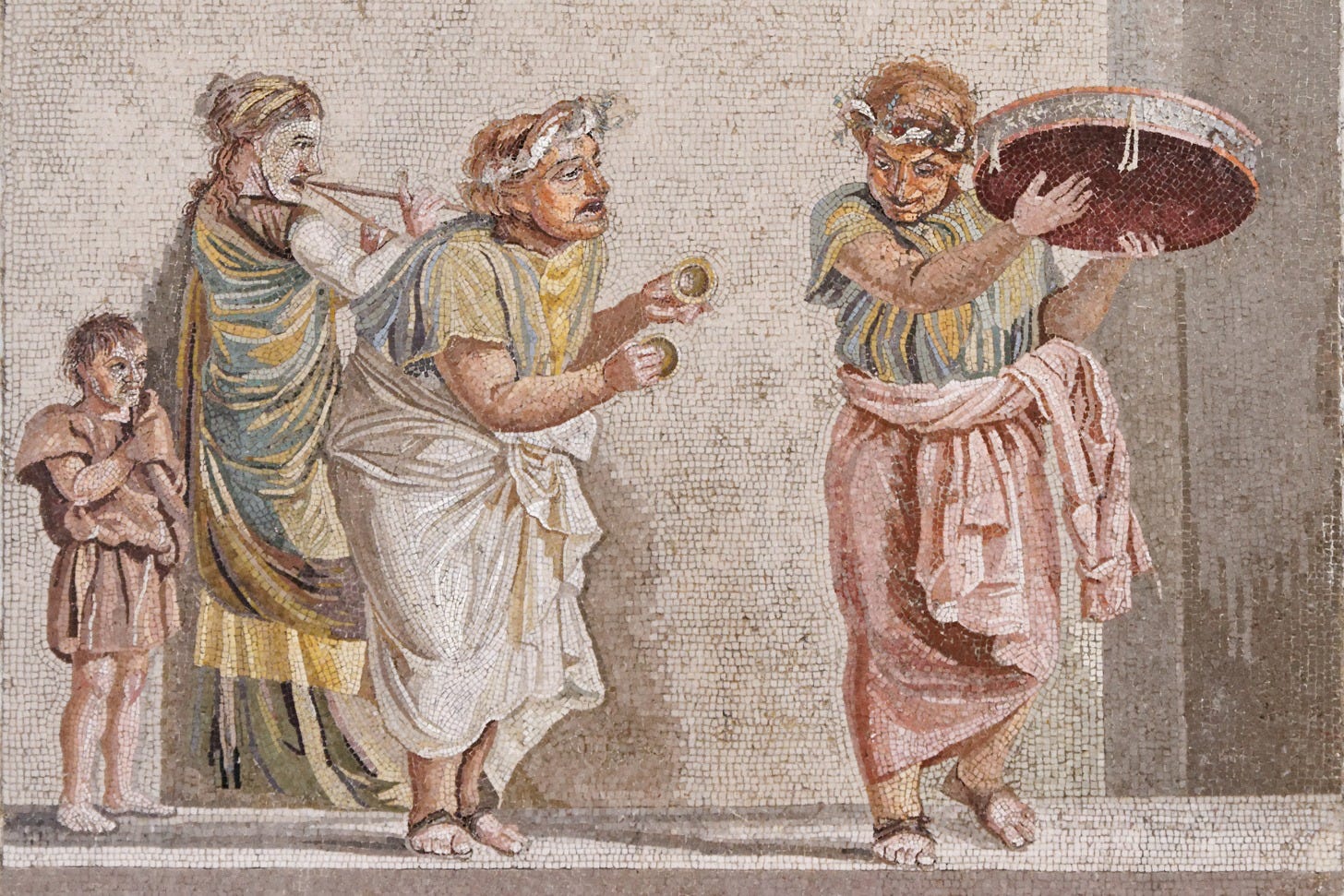
Street Musicians | Dioscurides of Samos, Pompeii, ca. 100 BCE
Why did the Romans bring an organ to the arena?
Key Terms for this Lesson
Hydraulis · Cornu · Colosseum
Greek Music in Roman Hands | Pipes, Lyres, & Rites
The Romans inherited their music, like their literature, from the Greeks (cf. Sec. 7.4). Most professional musicians in Rome were Greek, and the instruments were Greek too: the lyre and the double pipe the Greeks called the aulos (cf. Sec. 6.4), which the Romans called the tibia. As with the Greeks, music in Rome was rarely heard on its own. It belonged to occasions. A piper played at every Roman sacrifice (cf. Sec. 8.2), so that no ill-omened sound would be heard while the prayer was spoken.
The Greeks had made music part of a citizen’s education (cf. Sec. 6.4), but Roman aristocrats were warier of it. The biographer Cornelius Nepos (d. ca. 24 BCE) warned his Roman readers that Greeks did not share their view that singing and dancing in public were unbecoming to a man of rank. Rome’s great families paid for music. They did not, as a rule, perform it. Yet music could still carry the state’s highest hopes. In 17 BCE, Augustus held the Secular Games, a festival to mark the start of a new age, and a chorus of 27 boys and 27 girls sang a hymn written for the occasion by the poet Horace (d. 8 BCE), the Carmen Saeculare, on the Palatine and the Capitoline hills. An inscription recording the festival still names him as its composer.
Roman music grew louder and larger as the city grew. Theaters staged pantomime, a dancer who acted out a myth wordlessly while a chorus sang and an orchestra kept time, and pantomime dancers became some of the most famous performers in the empire. The Stoic philosopher Seneca (d. 65 CE) noticed the change, and he used a Roman concert as a picture of the well-ordered mind:
Do you not see how many voices there are in a chorus? Yet out of the many only one voice results. … in our present-day exhibitions we have a larger number of singers than there used to be spectators in the theatres of old. All the aisles are filled with rows of singers; brass instruments surround the auditorium; the stage resounds with flutes and instruments of every description; and yet from the discordant sounds a harmony is produced. Moral Letters to Lucilius (84.9–10, trans. Richard M. Gummere)
The Water Organ | An Engineer’s Instrument
One of the loudest instruments in the ancient world was the hydraulis, the water organ. It was invented in the 200s BCE by the engineer Ctesibius of Alexandria (cf. Sec. 7.1), the Hellenistic capital of science. Hand pumps pushed air into a bronze chamber that stood upside down in a tank of water. The weight of the water kept the air under steady pressure, so the pipes sounded with an even, sustained tone instead of the gasping rhythm of the pumps. A keyboard of sliders opened the pipes, row by row. The Roman engineer Vitruvius took the trouble to describe the whole machine in his book on architecture (On Architecture 10.8).
Romans heard the water organ at games, banquets, and the theater. In 1931, archaeologists in Budapest (the Roman town of Aquincum) found the remains of an organ given to the town’s guild of cloth-makers in 228 CE, with its bronze pipes, 52 of them in four rows, still lying where it fell. The hydraulis is the ancestor of the pipe organ that still fills churches and concert halls today.
The Arena | Music for the Games
• 80 CE | The Colosseum opens in Rome
• 1st–2nd century CE | The Zliten mosaic shows arena musicians in North Africa
• 228 CE | The Aquincum organ is given to a guild
The greatest stage for Roman music was the amphitheater. The Flavian Amphitheater, known today as the Colosseum, opened in 80 CE and held some 50,000 spectators. Its games could last from morning until evening: processions, animal hunts, and gladiator combats. Like the gladiators, the musicians had a job. A floor mosaic from Zliten in Libya shows a water organ and its player in the arena, beside players of the cornu, a great curved bronze horn that wrapped around the player’s body. The same instruments appear together in a mosaic at Nennig in Germany, where the organist plays while the horn player stands beside him.
The cornu was the voice of command. It began as an army instrument. A Roman legion moved by sound: the straight trumpet (tuba) gave the signal to advance or retreat, and the cornu called the standards to move, so that thousands of soldiers could act as one. The same horn came to the arena, where it signaled the start of a contest and marked its turns. The organ filled the stone bowl with sound that tens of thousands could hear above their own cheering, and it gave the long spectacle a rhythm. Rome’s crowds had bread and games (cf. Sec. 8.3), and the games had a soundtrack.
The organ outlived the arena. When the games ended in the 400s and 500s CE, the organ was still being built in Constantinople, and in 757 CE an emperor there sent one west to the Frankish king Pippin. From there it would one day reach the churches of Europe.
Sec 8 • The Romans
8.1 History & Politics • From Republic to Empire
8.2 Religion • Household Gods & the Imperial Cult
8.3 Literature & Drama • The Aeneid & Roman Satire
8.4 Art & Architecture • Aqueducts & Arches
8.5 Music • The Water Organ & the Arena
8.6 Philosophy • Stoicism & Roman Law
Course Page: Humanities I & II