

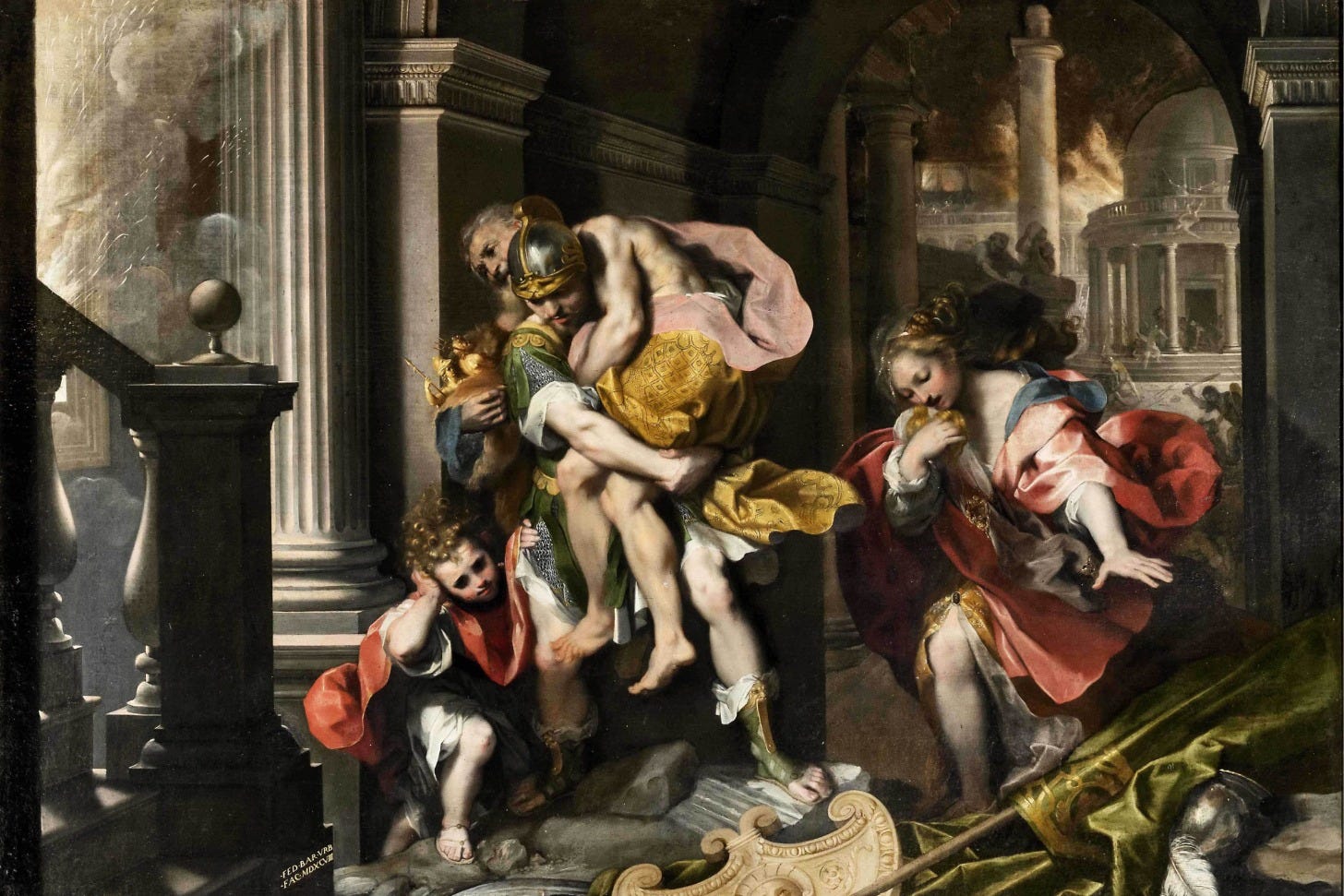
Aeneas’ Flight from Troy | Federico Barocci, 1598
Why did Rome’s greatest poet ask for his masterpiece to be burned?
Key Terms for this Lesson
Aeneid · Pietas · Satire
Greek Models | Ennius, Plautus, & Vergil
Rome learned to write literature from the Greeks (cf. Sec. 7.1). One of the first Roman poets, Ennius (d. 169 BCE), wrote the Annals, an epic of Roman history in the meter of Homer (cf. Sec. 6.2). Roman comedy also developed during the Republic. Plautus (d. 184 BCE) and Terence (d. 159 BCE) both wrote Roman adaptations of Greek comedies (cf. Sec. 7.5), and their plots of lost twins and clever servants still run through the comedies of Shakespeare.
Under Augustus, art and literature were expected to serve the state, and the poet Vergil (d. 19 BCE) played by the emperor’s rules. He was a farmer’s son from near Mantua, and today he is considered the greatest Roman author. With the emperor’s friend Maecenas as his patron, he wrote poems on shepherds and on farming, and Augustus himself sat through a four-day reading of the second. Then he began the Aeneid, an epic of twelve books on the founding of Rome. His ancient biographer called it “a mirror of both the poems of Homer” (Suetonius, Life of Vergil 21, trans. J. C. Rolfe). Its first six books follow a wanderer home like the Odyssey, and its last six fight a war like the Iliad.
Vergil worked on the Aeneid for more than a decade and died before he could finish revising it. On his deathbed in 19 BCE, he “constantly called for his book-boxes, intending to burn the poem himself” (Life of Vergil 39, Rolfe). His friends refused. Augustus had it published with only light corrections, unfinished half-lines and all, and Rome had its national epic.
Aeneas | Pietas & Empire without End
The Aeneid is the story of the Trojan warrior Aeneas’ flight from the Greeks’ destruction of Troy and his search for a new home. Aeneas is the son of the goddess Venus, who helps him escape the burning city. He carries his old father, Anchises, on his shoulders, leads his young son by the hand, and brings the household gods of Troy with him (cf. Sec. 8.2). The poem’s first lines promise that he will “found a city and carry his gods into Latium” (1.5–6, trans. J. W. Mackail). What drives Aeneas is pietas, his duty to the gods, his country, and his family, and Vergil’s name for him is pius Aeneas. Like Homer’s epithets (cf. Sec. 6.2), the name tells the reader what kind of man this is.
Aeneas’ duty costs him dearly. Storms drive him to Carthage, where Queen Dido welcomes the Trojans and comes to love him, but the gods command him to sail on to Italy. Her curse on his descendants becomes, in the poem, the ancient cause of the Punic Wars (cf. Sec. 8.1). In the underworld, his father’s spirit shows him the Romans yet to be born, and gives Rome its charge: “to rule the nations in thine empire… to lay down the law of peace, to be merciful to the conquered and beat the haughty down” (6.851–853, Mackail). Early in the poem, Jupiter himself sets the terms:
Thence shall Romulus, gay in the tawny hide of the she-wolf that nursed him, take up their line, and name them Romans after his own name. I appoint to these neither period nor boundary of empire: I have given them dominion without end. Aeneid (1.275–279, trans. J. W. Mackail)
Here was Rome’s vision of an “empire without end” (imperium sine fine), and Augustus’ family stood at its center. By legend, Aeneas’ son Iulus gave his name to the Julian family of Julius Caesar and of Augustus, his heir (cf. Sec. 8.1).
Satire | Juvenal & the City
The Romans claimed one genre as entirely their own. “Satire, on the other hand, is all our own,” wrote the teacher of rhetoric Quintilian (Institutes of Oratory 10.1.93, trans. H. E. Butler). Satire (Latin satura, a “full dish” of many things) mocks the follies of its own society, and its greatest Roman master was Juvenal (d. after 127 CE). Juvenal wrote under the emperors Trajan and Hadrian, a century after Augustus, and his poems show the modern reader that Rome was not paradise, whatever its monuments claimed.
Rome was plagued by overcrowding, its people crammed into rickety apartment blocks, and its streets filthy and teeming with crime. Juvenal wrote about all of this with biting sarcasm. One speaker in his third satire is leaving the city for good, to escape “the perpetual dread of fires and falling houses, and the thousand perils of this terrible city, and poets spouting in the month of August!” “Who but the wealthy get sleep in Rome?” he asks, kept awake by wagons in the narrow streets (Satires 3.7–9, 3.235, trans. G. G. Ramsay). A later tradition says Juvenal’s sharp tongue got him exiled to Egypt, though the story is uncertain.
Juvenal’s most famous line remembers the Republic Augustus said he had restored. Rome’s “people that once bestowed commands, consulships, legions and all else, now meddles no more and longs eagerly for just two things—Bread and Games!” (Satires 10.77–81, Ramsay).
Sec 8 • The Romans
8.1 History & Politics • From Republic to Empire
8.2 Religion • Household Gods & the Imperial Cult
8.3 Literature & Drama • The Aeneid & Roman Satire
8.4 Art & Architecture • Aqueducts & Arches
8.5 Music • The Water Organ & the Arena
8.6 Philosophy • Stoicism & Roman Law
Course Page: Humanities I & II