

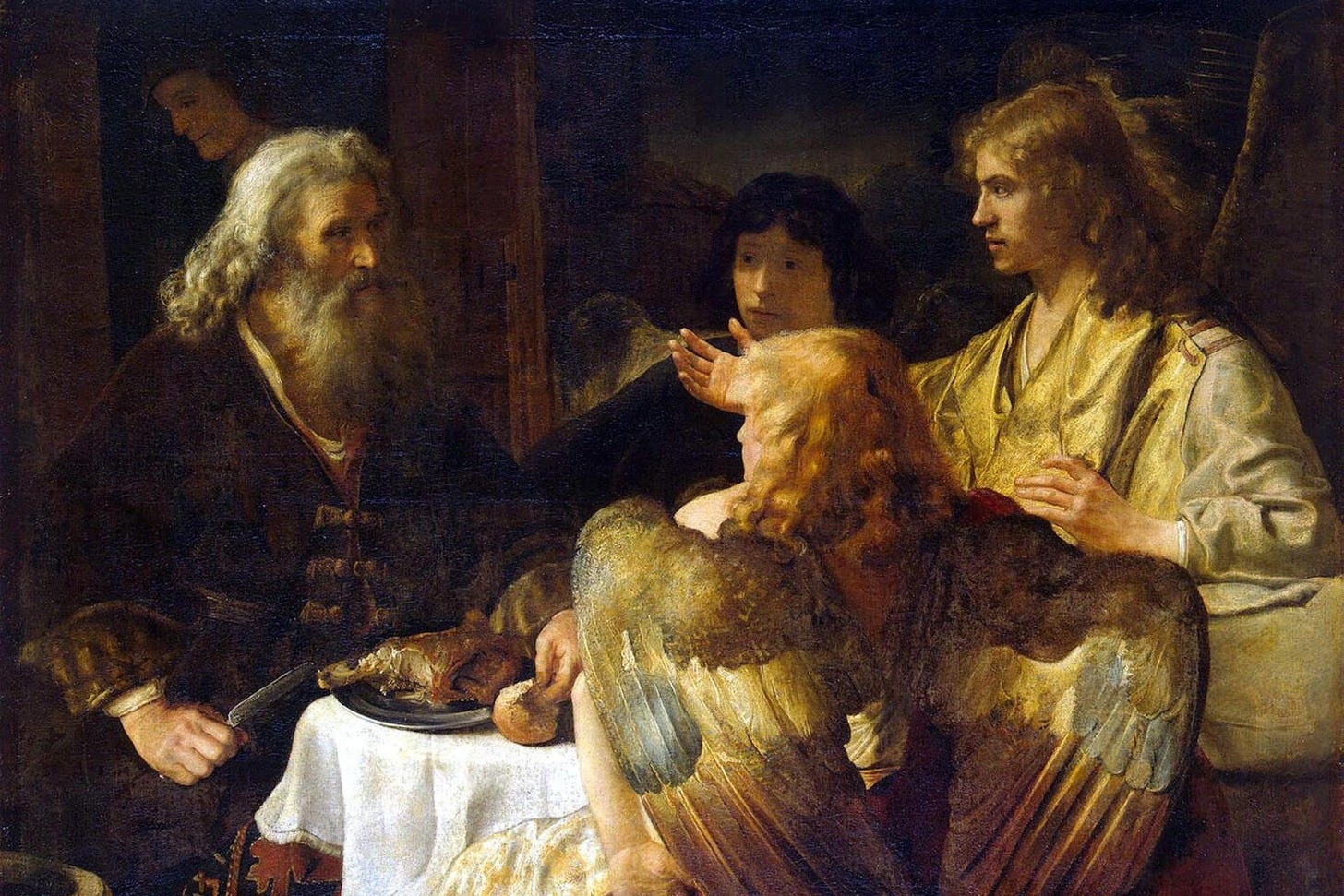
Abraham and the Three Angels | Jan Victors, 1640s (cropped)
Why did Abraham leave Ur for a land he had never seen?
Key Terms for this Lesson
Patriarchs · Exodus · Babylonian Exile
The Patriarchs & the Exodus
Welcome to Module III, The Abrahamic Traditions (cf. Sec. 1.2). Between Mesopotamia and Egypt was the ancient land of Canaan. The former Canaanite territories are found in modern Israel, Lebanon, Palestine, and parts of modern Jordan & Syria.
For Israel’s earliest centuries, the Bible is nearly our only written source, so this lesson tells the story as the Bible tells it.
Genesis opens with Creation, Adam, and Noah’s flood (cf. Sec. 2.5). Israel’s first period is the age of the patriarchs, the fathers of the tribe: Abraham, his son Isaac, and his grandson Jacob. In Genesis, Abraham and his family are led out of Mesopotamia, from Ur of the Chaldeans (Ur Kaśdim), into the Land of Canaan (Genesis 11:31). Ur was one of the great cities of its age, with its ziggurat and its royal tombs (cf. Sec. 2.2, 2.3, 2.4). The call comes anyway:
Get thee out of thy country, and from thy kindred, and from thy father’s house, unto a land that I will shew thee: And I will make of thee a great nation, and I will bless thee, and make thy name great; and thou shalt be a blessing… Genesis 12:1–2 (KJV)
Abraham left because he was called, and the call came with a promise: a nation, a name, and a blessing.
Then comes the land: “Unto thy seed will I give this land” (Genesis 12:7). This is the Promised Land. Jacob is renamed Israel, and his twelve sons become the twelve tribes. One son, Joseph, is sold into Egypt and rises to save it from seven years of famine (Genesis 41, cf. Sec. 3.1), and the family follows him there.
The Exodus (Greek for “going out”) is when Moses leads the Hebrew people out of Egyptian bondage. At Mount Sinai they receive the Law (cf. Sec. 9.2). Forty years later, Joshua leads the tribes into Canaan. Egypt’s records do not name Moses. They do name Israel. Pharaoh Merneptah’s victory stele of 1208 BCE carries the earliest mention of Israel in the archaeological record (cf. Sec. 3.1).
The House of David | ca. 1200–930 BCE
At the outset of the Iron Age (cf. Sec. 1.6), when Egypt withdraws from Canaan, a power vacuum opens. In the central hill country, a highland culture begins to present itself as distinct from its Canaanite neighbors: its language is Hebrew, and its name for itself is Israel. In the Book of Judges, its tribes have no king. In a crisis, God raises up a judge. Then the elders come to the aging prophet Samuel and ask for something new. Samuel warns them what a king will take (1 Samuel 8:11–17). They ask anyway:
Nay; but we will have a king over us; That we also may be like all the nations; and that our king may judge us, and go out before us, and fight our battles. 1 Samuel 8:19–20 (KJV)
The battles were real. The Philistines, an Aegean people settled on the coast around present-day Gaza, pressed on Israel from the west. Israel’s first king, Saul, fights them. A shepherd boy named David humbles the Philistines by killing their champion, Goliath, with a sling and a stone (1 Samuel 17:50, cf. Sec. 3.5) and later is made king. Once he is anointed (Hb. mashiach), David moves the capital from Hebron to Jerusalem, thereafter the ‘City of David.’ His son Solomon builds the Temple there (cf. Sec. 9.3).
Within four centuries of the Bronze Age Collapse, the archaeological record attests to an Israelite dynasty called the House of David. The words turned up in 1993 on a broken slab of basalt at Tel Dan, carved by an Aramean king boasting of victory over the king of Israel and the ‘House of David.’
Exile & Return | 930–538 BCE
After Solomon, the kingdom splits in two.
• ca. 930 BCE | The Divided Monarchy: Israel in the north, Judah in the south
• 722 BCE | Assyria takes the Northern Kingdom
• 586 BCE | Babylon (~Iraq) takes the Southern Kingdom, causing the Babylonian Exile
• 538 BCE | Persia (~Iran) ends the Exile
In 586 BCE, Nebuchadnezzar II (d. 562 BCE) destroyed Jerusalem and Solomon’s Temple (cf. Sec. 2.4). Babylon resettled many of Judah’s people in its own lands, in an event known as the Babylonian Exile. Because the exiles came from the Tribe of Judah, they were henceforth called Judeans (Hb. Yehudim), the root of our word Jews.
Then, in 539 BCE, Persia took Babylon (cf. Sec. 2.1), and Jewish scripture pays an astonishing compliment to a foreign king. The Persian Cyrus (d. 530 BCE) is the only non-Jew whom the Bible calls God’s anointed (Isaiah 45:1). By about 516 BCE, the Second Temple stood in Jerusalem. It will stand for nearly six centuries before its destruction at the hands of the Romans (cf. Sec. 9.5).
Sec 9 • Ancient Israel
9.1 History & Politics • The Promised Land & David
9.2 Religion • Covenant, Shabbat, & Mitzvot
9.3 Art & Architecture • The Ark & Temple
9.4 Music • The Psalms
9.5 Literature & Drama • The Torah & Talmud
9.6 Wisdom • Justice, Lovingkindness, & Repentance
Course Page: Humanities I & II