

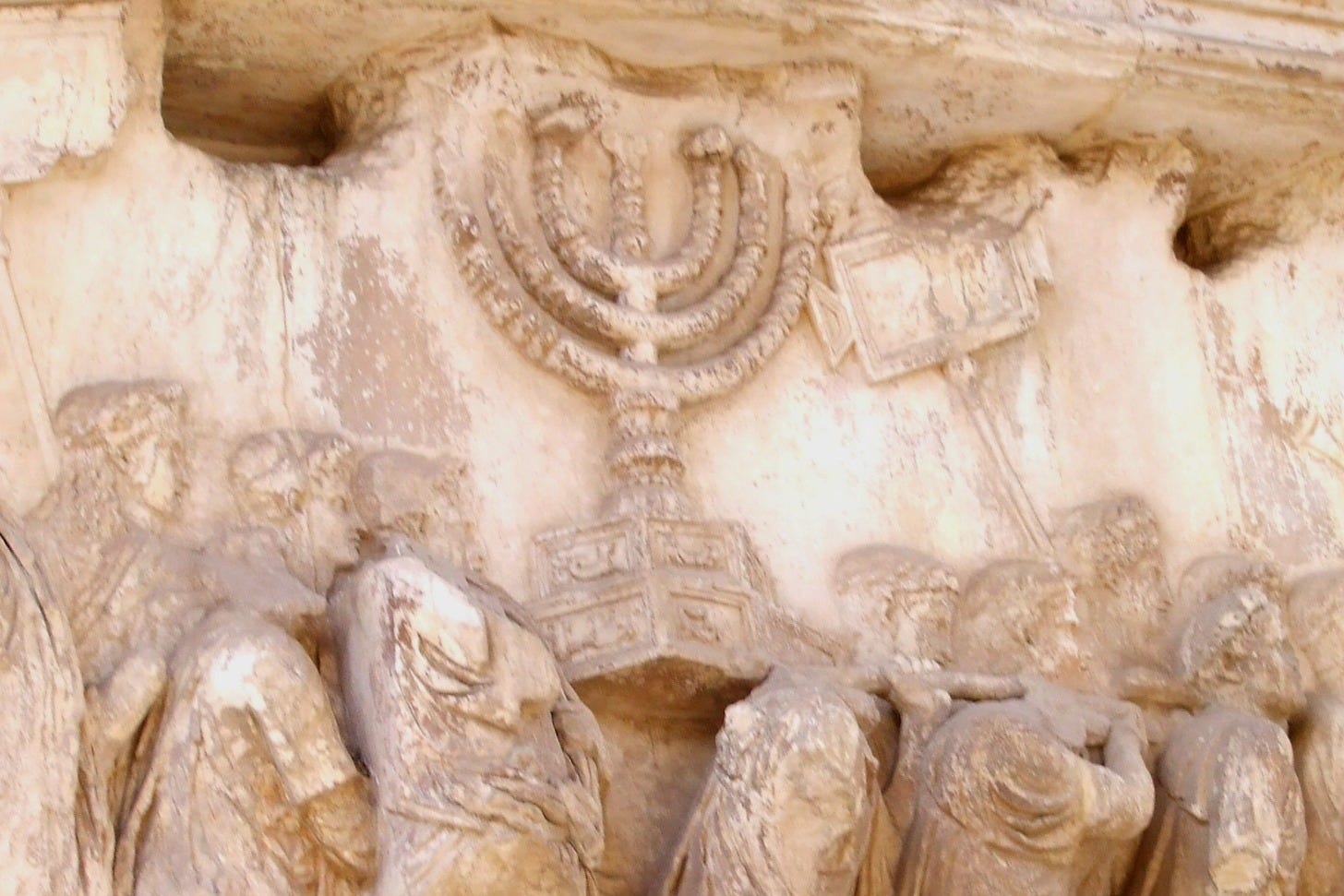
The Spoils of Jerusalem | Arch of Titus, Rome, ca. 81 CE (detail)
Photo Credit: Laurel Lodged via Wikimedia Commons
Why did Israel build a temple with no statues?
Key Terms for this Lesson
Ark of the Covenant · Holy of Holies · Menorah
The Ark | A Throne Without a Statue
Every temple in this course so far was built as a house for a god’s image. The ziggurat of Ur lifted a shrine to the moon god Nanna (cf. Sec. 2.3). The Parthenon held Athena in gold and ivory, nearly forty feet tall (cf. Sec. 7.2). Rome raised its Pantheon to “all the gods” (cf. Sec. 8.4). Israel’s sanctuary was built around a box.
In the wilderness, Moses receives a command: “let them make me a sanctuary; that I may dwell among them” (Exodus 25:8). The sanctuary is a portable tent, the Tabernacle (Hb. mishkan, “dwelling”). At its heart stands the Ark of the Covenant: a chest of acacia wood about 45 inches long, overlaid with gold, holding the two stone tablets of the Ten Commandments (Exodus 25:10–11, 1 Kings 8:9). On its golden lid, the mercy seat, two cherubim face each other with their wings stretched over it. Between the wings, there is nothing.
And there I will meet with thee, and I will commune with thee from above the mercy seat, from between the two cherubims which are upon the ark of the testimony… Exodus 25:22 (KJV)
The empty space is the point. The second commandment forbids “any graven image, or any likeness of any thing” (Exodus 20:4, cf. Sec. 9.2). Yet the same Torah demands fine art. Its craftsman, Bezaleel, is the first person the Bible says God filled “with the spirit of God,” and the gift named is “all manner of workmanship” (Exodus 31:2–3). Gold, woven linen, and carved cherubim were holy. An image of God was not.
The First Temple | Solomon’s House | ca. 957–586 BCE
When David brings the Ark to Jerusalem, he dances before it with the whole house of Israel (cf. Sec. 3.3, 9.4). He also plans a permanent Temple. But God tells him, “Thou hast shed blood abundantly… thou shalt not build an house unto my name” (1 Chronicles 22:8). The task falls to his son Solomon, with cedar from Lebanon and craftsmen sent by Hiram, king of Tyre. This is the Great Temple of Solomon (ca. 957–586 BCE), whose focal point is the Holy of Holies (Kodesh HaKodashim): a perfect cube of 20 cubits, about 30 feet on each side, lined in gold, which held the Ark (1 Kings 6:20). Its site remains the holiest place on earth for the Jewish people.
At its dedication, Solomon himself asks the question behind that empty room:
But will God indeed dwell on the earth? behold, the heaven and heaven of heavens cannot contain thee; how much less this house that I have builded? 1 Kings 8:27 (KJV)
A temple that could not contain its God could not hold His statue either. The First Temple fell when it was destroyed by the invading Babylonians in 586 BCE (cf. Sec. 9.1). On what became of the Ark, the ancient accounts disagree.
The Second Temple | Menorah & the Arch of Titus
Rebuilt with Persian funds, the Second Temple was completed in Jerusalem around 516 BCE (cf. Sec. 9.1), and it has forevermore been the focal point of Jewish memory. Its Holy of Holies stood empty. No Ark was ever recovered. In 63 BCE, the Roman general Pompey (cf. Sec. 8.1) took Jerusalem and walked into the one room only the high priest could enter, once a year (cf. Sec. 9.6). The Roman historian Tacitus (d. ca. 120 CE) recorded what Rome learned there:
Availing himself of the right of conquest, he entered the temple. Thus it became commonly known that the place stood empty with no similitude of gods within, and that the shrine had nothing to reveal. Histories (5.9, trans. Alfred John Church & William Jackson Brodribb)
Outside that room stood the menorah, the Temple’s seven-branched lampstand of beaten gold (Exodus 25:31). In about 20 BCE, King Herod the Great (d. 4 BCE) began rebuilding the Temple on a grand scale. It burned when Rome took Jerusalem in 70 CE (cf. Sec. 9.5). On the Arch of Titus in Rome (ca. 81 CE), carved Roman soldiers still carry the menorah away as spoils in a triumph (cf. Sec. 8.4).
The Temple is gone, but its outline remains. Today, the Western Wall, an outer retaining wall of Herod’s Temple Mount complex, remains the focal point of Jewish prayer. And walk into any synagogue: at the front stands the ark, and within it is a Torah scroll. Above it burns the ner tamid (the eternal lamp).
Sec 9 • Ancient Israel
9.1 History & Politics • The Promised Land & David
9.2 Religion • Covenant, Shabbat, & Mitzvot
9.3 Art & Architecture • The Ark & Temple
9.4 Music • The Psalms
9.5 Literature & Drama • The Torah & Talmud
9.6 Wisdom • Justice, Lovingkindness, & Repentance
Course Page: Humanities I & II