

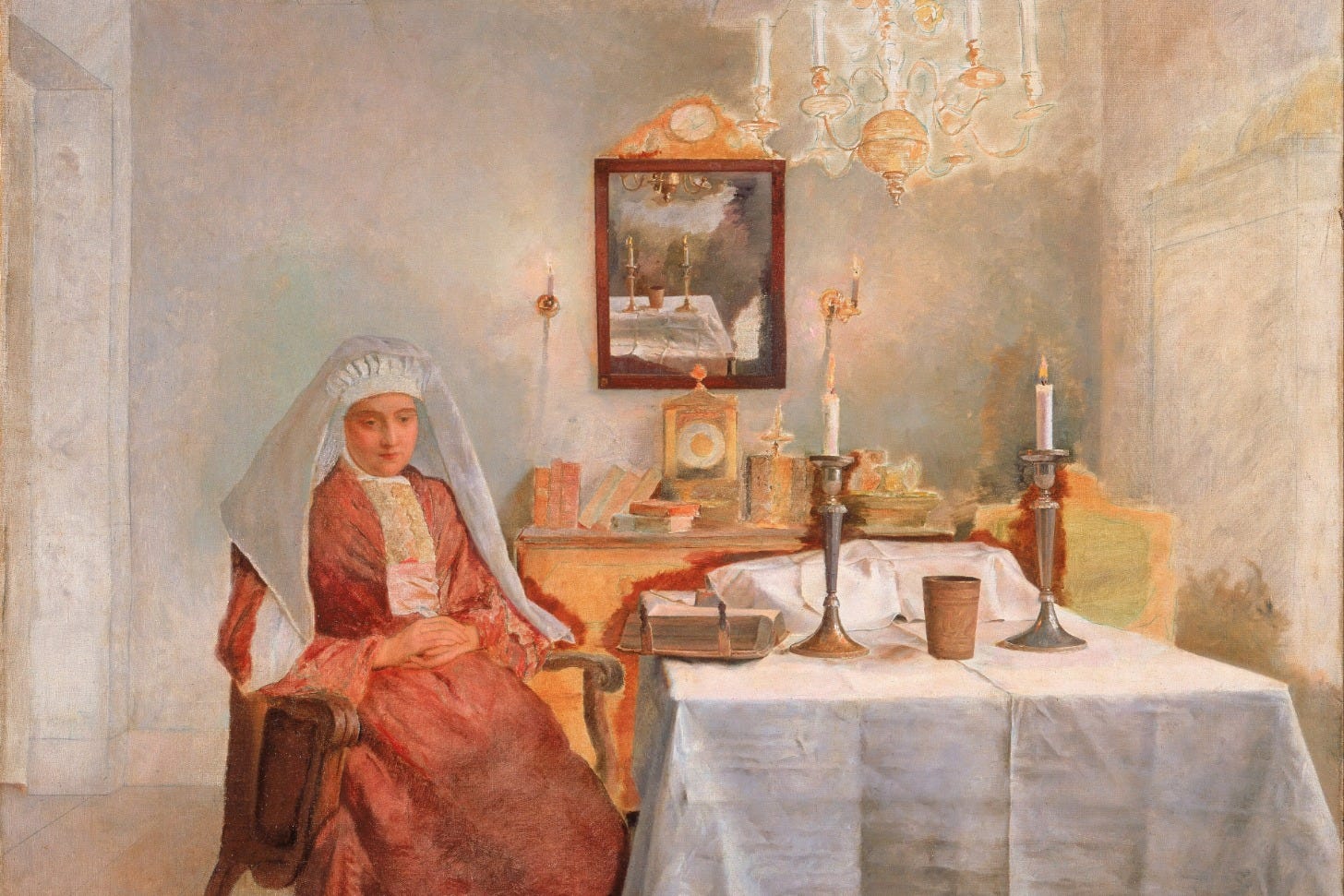
Friday Evening | Isidor Kaufmann, ca. 1920 (cropped)
Why did Israel cease all work on Saturday?
Key Terms for this Lesson
Covenant · Shabbat · Mitzvot
Covenant | Hammurabi, Abraham, & the Shema
About 3,800 years ago, in Mesopotamia (~Iraq), the Code of Hammurabi was cut into a tall stone pillar and set up for all to see (cf. Sec. 2.6). Above the laws, the monument pictures a covenant, a sacred two-way agreement, between the king and Shamash, the Mesopotamian god of justice. At its top, the god hands Hammurabi the symbols of his rule. The king, for his part, promised to uphold justice and protect the weak. That bargain mirrored the politics of the age. A small vassal state offered its allegiance to a great king in exchange for protection.
It is the same shape the Bible gives to the relationship between God and Israel.
The covenant (Hb. berit) Abraham makes with God in Genesis 17 is the same two-way bargain. In this “everlasting” covenant, Abraham’s children are promised the Land of Canaan forever, and God in turn will protect those children, the Israelites. In its shortest form: “ye shall be my people, and I will be your God” (Jeremiah 30:22).
Here the likeness to Hammurabi ends. Shamash was one god among many (cf. Sec. 2.2). Israel’s covenant is with one God alone, and its creed is a single verse, the Shema: “Hear, O Israel: The LORD our God is one LORD” (Deuteronomy 6:4). This is monotheism, mono meaning one and theism meaning god. Egypt’s Akhenaten had raised up one god before (cf. Sec. 3.2), but his Aten was the pharaoh’s own and was abandoned soon after his death. Israel’s God was bound to a whole people, by a promise and a law, and could not be pictured in any image (Exodus 20:4, cf. Sec. 9.3).
Shabbat | The Seventh Day
It’s sundown on Friday.
A Jewish wife lights two candles, covers her eyes, and says the blessings. Someone lifts a cup and blesses it, then uncovers two loaves of braided bread (challah) and blesses those. There is a meal with speaking parts. And no one is looking at a phone.
This is the beginning of Shabbat (the Sabbath), the sacred day of Jewish rest and the most important holiday on the Jewish calendar. It comes every week! In the Genesis narrative, God made the world in 6 days and rested on the 7th, sanctifying it as a day of rest (Genesis 2:2–3). The Ten Commandments make it law:
Remember the sabbath day, to keep it holy. Six days shalt thou labour, and do all thy work: But the seventh day is the sabbath of the LORD thy God: in it thou shalt not do any work, thou, nor thy son, nor thy daughter, thy manservant, nor thy maidservant, nor thy cattle, nor thy stranger that is within thy gates… Exodus 20:8–10 (KJV)
Notice who rests: the servant, the stranger, and even the cattle. No other people of the ancient world stopped all work on a weekly day, for everyone at once. Deuteronomy gives the reason in Israel’s own memory: “remember that thou wast a servant in the land of Egypt” (Deuteronomy 5:15). A people freed from bondage gave a day of freedom to everyone in the house. The Torah calls Shabbat “a sign between me and the children of Israel for ever” (Exodus 31:17).
Shabbat begins at sundown Friday and ends at nightfall Saturday, a 25-hour pause from the demands of everyday life for reflection, family, synagogue, and community. On the 7th day, Jews rest inside a weekly foretaste of the Messianic Age, when everyone has enough (Micah 4:4) and no one studies war anymore (Isaiah 2:4).
Mitzvot | The Path of the Commandments
Shabbat is one of the Torah’s commandments. Literally “the Path,” Halacha is generally translated “Jewish Law”: the sum of all Jewish wisdom and tradition, centered on the 613 mitzvot (Hb. commandments) of the Torah. By the rabbis’ count, 248 are positive (“thou shalt”) and 365 negative (“thou shalt not”). The Ten Commandments are the most famous of them. “Thou shalt love thy neighbour as thyself” is another (Leviticus 19:18).
Torah is also the source of kashrut: the Jewish dietary laws describing kosher food. These mitzvot govern which foods are permitted and how they are prepared: meat and dairy kept separate, and certain meats such as pork and shellfish prohibited. Many modern Jews keep kosher as a mode of intentional living.
Like dharma in India, li in China, and the mos maiorum in Rome, the mitzvot are a way of life before they are a creed (cf. Sec. 4.3, 5.4, 8.2). They reach the kitchen, the calendar, and the workweek.
From a Jewish perspective, the covenant with God made through Abraham is absolute.
Sec 9 • Ancient Israel
9.1 History & Politics • The Promised Land & David
9.2 Religion • Covenant, Shabbat, & Mitzvot
9.3 Art & Architecture • The Ark & Temple
9.4 Music • The Psalms
9.5 Literature & Drama • The Torah & Talmud
9.6 Wisdom • Justice, Lovingkindness, & Repentance
Course Page: Humanities I & II