

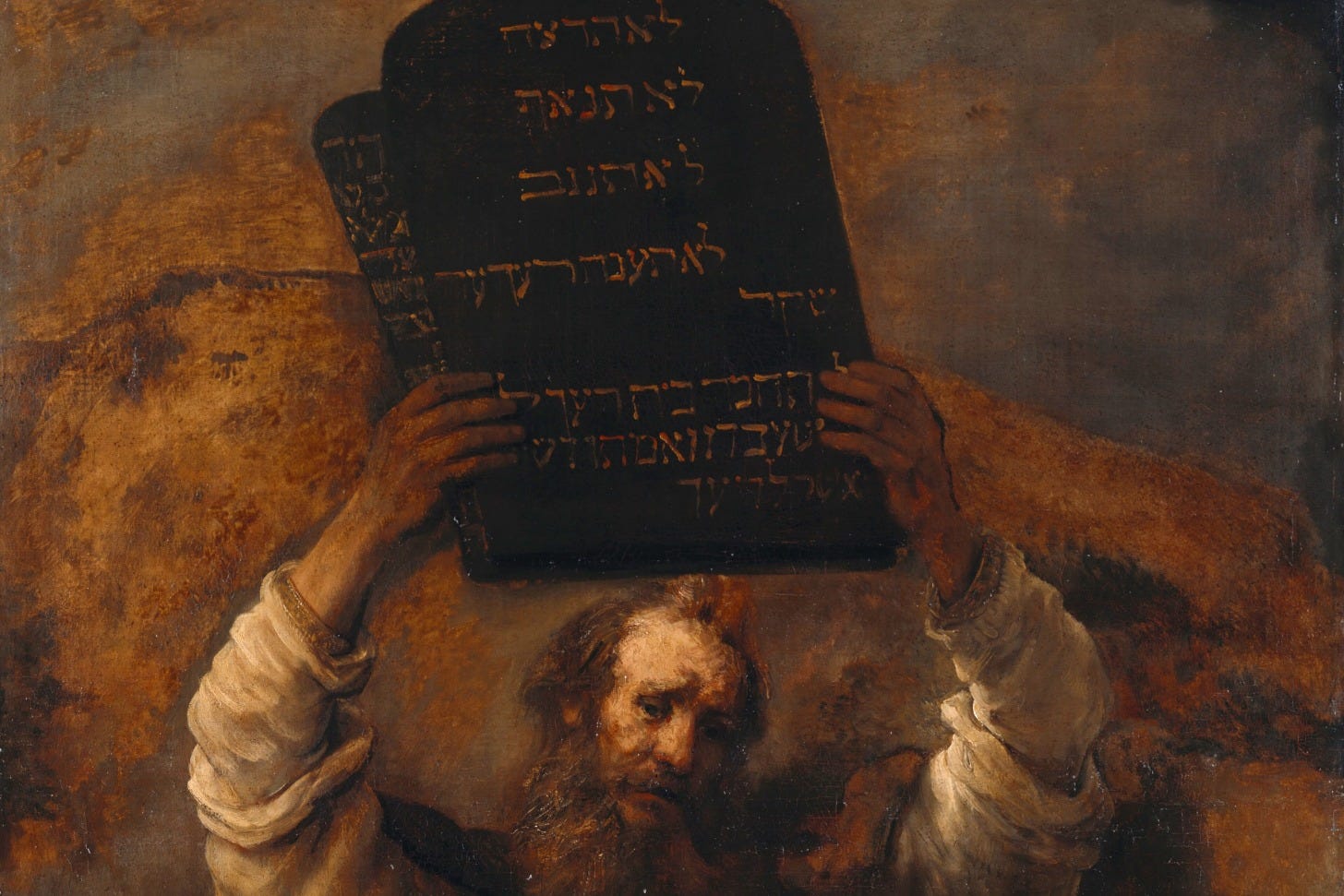
Moses with the Ten Commandments | Rembrandt, 1659 (detail)
Why did the rabbis spend 400 years arguing over the Torah?
Key Terms for this Lesson
Tanakh · Torah · Talmud
The Tanakh | Torah, Prophets, & Writings
At the center of Jewish life is the Hebrew Bible, what Christians call the Old Testament. Jews call it the Tanakh, a name built from the first letters of its three layers, TA-NA-KH:
• The Torah (Hb. instruction): the first 5 scrolls of the Bible
• The Nevi’im (Hb. Prophets): 8 scrolls of prophetic insight for Israel
• The Ketuvim (Hb. Writings): 11 other scrolls, poetic, wisdom, and histories
The Torah is the books of Genesis, Exodus, Leviticus, Numbers, and Deuteronomy, traditionally attributed to Moses. It holds the stories and the commandments of the first two lessons (cf. Sec. 9.1, 9.2). The Nevi’im begin with the Former Prophets, the histories from Joshua through Kings, and continue with the Latter Prophets, the books of Isaiah, Jeremiah, Ezekiel, and the Twelve. Two of them, Jeremiah and Ezekiel, belong to the same age as the Buddha and Confucius (cf. Sec. 4.4). The Ketuvim gather everything else: the Psalms (cf. Sec. 9.4), Proverbs, Job’s even balance and Daniel’s writing on the wall (cf. Sec. 3.6), and the Teacher of Ecclesiastes, who tells his reader to eat his bread with joy (cf. Sec. 3.3).
The text of the Hebrew Bible is almost entirely ancient Hebrew (98.8%), with the remaining 1.2% composed in Aramaic. From the start, the Torah was a book to study. God charges Joshua to keep “this book of the law” close: “thou shalt meditate therein day and night” (Joshua 1:8).
The Temple Burns | From Sacrifice to Study
Rome takes Jerusalem in 63 BCE, under Pompey (cf. Sec. 8.1, 9.3), and thereafter rules through puppet-kings, Herod the Great chief among them. Against Roman imperialism rose the Zealots, who sought to defeat their imperial masters by force. Their struggle became the First Jewish–Roman War (66–73 CE). Its turning point was the Roman destruction of the Temple in 70 CE. For Jews, the losses in the Jewish–Roman War were the most cataclysmic loss in their history until the Holocaust.
Did you ever wonder why there are no more Jewish sacrifices? It’s because a Third Temple was never built. The covenant had been kept at an altar in Jerusalem, and now there was no altar. With the Temple gone, Jewish life turned to the Pharisees, the party of the people:
• The Temple in Jerusalem was succeeded by synagogues (Gr. assemblies)
• The Temple priesthood was succeeded by rabbis (Hb. my teacher)
• The Temple sacrifices were succeeded by the study of the Torah
In these ways, after the Temple, Rabbinic Judaism was born: focused on Torah study, rabbinic tradition, and synagogue attendance.
The Talmud | Mishnah & Gemara
The rabbis held that Moses received two Torahs at Sinai: the Written Torah and an Oral Torah that explains it, handed down teacher to student. The Mishnah’s tractate Pirqe Aboth (the Sayings of the Fathers) opens with that chain:
Moses received the Thorah from Sinai, and he delivered it to Jehoshua’, and Jehoshua’ to the elders, and the elders to the prophets, and the prophets delivered it to the men of the Great Synagogue. Pirqe Aboth (1.1, trans. Charles Taylor)
After the fall of the Temple, the rabbis spent the next 400 years writing that tradition down as the Talmud, an enormous body of commentary that rules on the questions Jewish life put to the Torah. The first layer of the Talmud was the Mishnah, completed around 200 CE. For example, while the Torah commands Jews to leave part of their harvest to the poor (Deuteronomy 24:19), the Mishnah adds that the poor who are not Jews may glean too. Why? Because Jews should act “for the sake of the ways of peace” (Gittin 5:8). Over the next 300 years, the rabbis of Babylonia (~Iraq) and the Land of Israel added a second layer of debate on the Mishnah, the Gemara. In sum, the Talmud is essentially the Mishnah (ca. 200 CE) and the Gemara (ca. 500 CE).
Page after page, the Sages set their opinions side by side, and each is tested for its logic and its consistency. Often, two rabbis reach views that are each internally sound and still contradict each other. When the schools of Hillel and Shammai argued for three years, the Talmud records a heavenly voice declaring that both were “the words of the living God,” though the law, in the end, follows Hillel (Eruvin 13b). There’s no bottom to Jewish thought.
With the Temple gone, study became how Israel kept the covenant, and argument became how it studied.
A famous story in the Talmud shows the whole method in one breath. A man asks the sage Hillel (d. ca. 10 CE) to teach him the entire Torah while he stands on one foot. Hillel answers: “What is hateful to you, do not do to your fellow. That is the whole Torah, and the rest is its commentary. Go and learn it” (Shabbat 31a, my translation).
Sec 9 • Ancient Israel
9.1 History & Politics • The Promised Land & David
9.2 Religion • Covenant, Shabbat, & Mitzvot
9.3 Art & Architecture • The Ark & Temple
9.4 Music • The Psalms
9.5 Literature & Drama • The Torah & Talmud
9.6 Wisdom • Justice, Lovingkindness, & Repentance
Course Page: Humanities I & II