

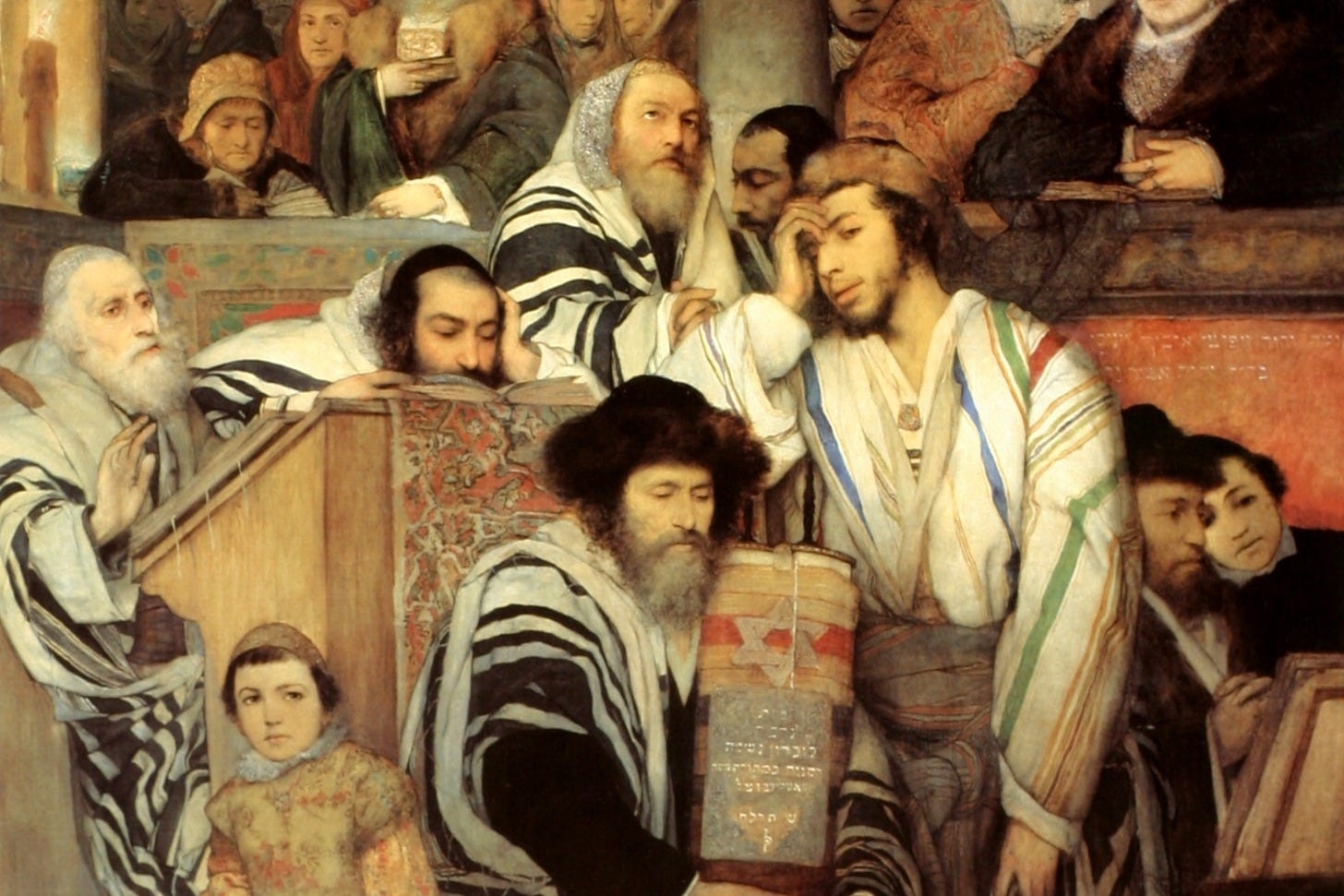
Jews Praying in the Synagogue on Yom Kippur | Maurycy Gottlieb, 1878 (detail)
Why did Israel spend ten days each year making things right with its neighbors?
Key Terms for this Lesson
Tzedakah · Hesed · Teshuvah
Tzedakah | Justice & the Prophets
In the ancient world, a god who was angry was a god who wanted an offering. In the Iliad, Agamemnon sends Apollo a hundred bulls and goats to end a plague (cf. Sec. 6.2). Meanwhile, in ancient Israel, the prophets will turn this entire worldview on its head. Israel had its altar and its offerings (cf. Sec. 9.3). But one prophet after another said that offerings were not what God asked first. The prophet Micah, active around 700 BCE, gives the tradition’s own summary:
Will the LORD be pleased with thousands of rams, or with ten thousands of rivers of oil?… He hath shewed thee, O man, what is good; and what doth the LORD require of thee, but to do justly, and to love mercy, and to walk humbly with thy God? Micah 6:7–8 (KJV)
Justice first. Amos cries, “let judgment run down as waters, and righteousness as a mighty stream” (Amos 5:24), and the Proverbs agree: “To do justice and judgment is more acceptable to the LORD than sacrifice” (Proverbs 21:3, cf. Sec. 2.6). The search for righteousness is a specific goal for Jews, insofar as the word righteous in Hebrew (tzadik) is a cognate of tzedakah, or charity. For Jews, righteousness and charity are connected at the level of grammar. Tzedakah is the Jewish obligation to act righteously toward those in need. It is the Torah’s duty to do justice.
Hammurabi’s justice was proportion by station: the penalty depended on the rank of the one harmed (cf. Sec. 2.6). The Torah has its “eye for eye” too (Exodus 21:24). But it demands “one manner of law, as well for the stranger, as for one of your own country” (Leviticus 24:22). And the rabbis read “eye for eye” as a payment, not a wound: whoever injures another pays for the damage, the pain, the healing, the lost work, and the shame (Bava Kamma 8:1).
Hesed | Lovingkindness Beyond the Law
Then Micah asks for more than justice: “to love mercy.” The Hebrew word is hesed, lovingkindness: loyal love that gives more than it owes. It is the virtue of Ruth, the Moabite woman who chose to make the Jewish people her own: “thy people shall be my people, and thy God my God” (Ruth 1:16). The Mishnah ranks it among the pillars of creation:
On three things the world is stayed; on the Thorah, and on the Worship, and on the bestowal of Kindnesses. Pirqe Aboth (1.2, trans. Charles Taylor)
The Talmud shows hesed working inside a court case. A rabbi hires porters to carry barrels for him, and they break one. Under the law, they owe him for it, and he takes their cloaks as payment. They appeal to the sage Rav, who tells the owner to give the cloaks back. Why? Because Proverbs says to “walk in the way of good men.” The porters add that they worked all day and have nothing to eat. Rav orders the owner to pay their full wages too, because the same verse says to “keep the paths of the righteous” (Bava Metzia 83a, Proverbs 2:20). True ethics often requires going beyond the letter of the law.
Teshuvah | The Days of Awe
The third word is teshuvah, repentance, and it means literally “to return.” The prophets call it a turn of the whole person: “turn yourselves, and live ye” (Ezekiel 18:31–32). David’s prayer after his own failure is its model: “Create in me a clean heart, O God” (Psalm 51:10).
While the Temple stood, once a year on the Day of Atonement (Yom Kippur), the high priest entered the Holy of Holies for the people (Leviticus 16:2, 34, cf. Sec. 9.3). Rosh Hashanah and Yom Kippur, the High Holy Days, stand at either end of the Ten Days of Awe, when Jews reaffirm the covenant between God and the Jewish people. Rosh Hashanah is the Jewish New Year, opened by the shofar, a ram’s horn, blown in the synagogue in long and broken blasts (cf. Sec. 9.4). The days that follow are given to introspection, repentance, and the renewal of one’s commitments to God and to one’s neighbors.
The tradition holds that a wrong done to another person cannot be forgiven by God until it has been set right with that person (Yoma 8:9), so the ten days are spent intentionally repairing the relationships in one’s life. Yom Kippur, the Day of Atonement, closes them with a full day’s fast, prayer from morning to nightfall, and the reading of the Book of Jonah, the story of a reluctant prophet and a city that repented: “God saw their works, that they turned from their evil way” (Jonah 3:10).
Sec 9 • Ancient Israel
9.1 History & Politics • The Promised Land & David
9.2 Religion • Covenant, Shabbat, & Mitzvot
9.3 Art & Architecture • The Ark & Temple
9.4 Music • The Psalms
9.5 Literature & Drama • The Torah & Talmud
9.6 Wisdom • Justice, Lovingkindness, & Repentance
Course Page: Humanities I & II
Next Section: Early Christendom