

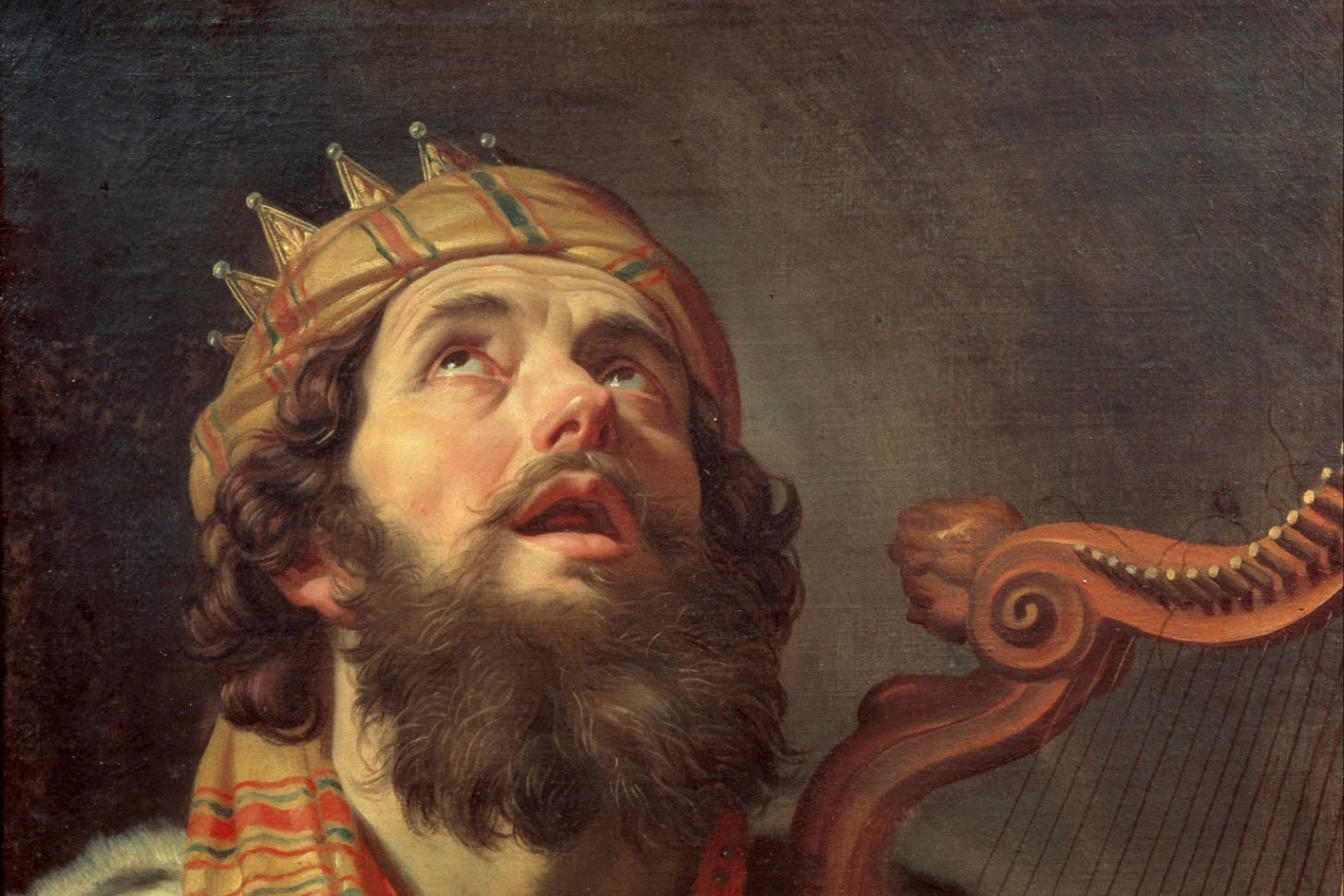
King David Playing the Harp | Gerard van Honthorst, 1622 (detail)
How do you sing a holy song in a strange land?
Key Terms for this Lesson
Book of Psalms · Kinnor · Levites
David’s Lyre | The Sweet Psalmist of Israel
The Bible remembers Israel’s greatest king as a musician first. Before David ever fights Goliath (cf. Sec. 9.1), he is brought to King Saul’s court because he can play: “David took an harp, and played with his hand: so Saul was refreshed” (1 Samuel 16:23). The KJV says “harp,” but the Hebrew word is kinnor, a small wooden lyre, cousin to the lyres buried with the kings of Ur fifteen centuries before (cf. Sec. 2.4). Late in life, David is called “the sweet psalmist of Israel” (2 Samuel 23:1).
Israel’s music was loud, and it was public. When David brings the Ark to Jerusalem, “David and all the house of Israel played before the LORD on all manner of instruments… even on harps, and on psalteries, and on timbrels, and on cornets, and on cymbals” (2 Samuel 6:5). The “cornets” were likely sistra, the rattles Egypt shook for Hathor (cf. Sec. 3.3). Then there is the shofar, a ram’s horn blown on the new moon and at the feasts (Psalm 81:3). It is the one instrument of the Temple still sounded in every synagogue today, in long and broken blasts on the Jewish New Year (cf. Sec. 9.6).
The Temple Choir | The Levites & the Book of Psalms
For the Temple, David organizes a professional choir. He “spake to the chief of the Levites to appoint their brethren to be the singers with instruments of musick, psalteries and harps and cymbals” (1 Chronicles 15:16). The Levites, the priestly tribe of Levi, became Israel’s hereditary Temple musicians, four thousand of them by the Chronicler’s count (1 Chronicles 23:5). Their leaders’ names still stand at the head of the songs: 12 psalms belong to Asaph, and 11 to the sons of Korah.
Those songs are gathered in the Book of Psalms: 150 sacred poems, sung in the Temple and gathered into five books. Its Hebrew name is Tehillim, “praises.” Our word psalm comes from the Greek psalmos, a song sung to a plucked string (from psallein, “to pluck”), and the psaltery is the plucked instrument named for it. Tradition credits 73 of the psalms to David himself. Many still carry directions for the musicians: “To the chief Musician on Neginoth” (i.e., on stringed instruments, Psalm 4). The word Selah appears 71 times in the Psalms. No one knows what it means, though most scholars take it for a musical pause.
The Psalms sing every human condition: the shepherd’s trust (“The LORD is my shepherd; I shall not want,” Psalm 23), the wonder at creation that Egypt’s hymn to the Aten shared (cf. Sec. 3.2, Psalm 104), and they even play with the alphabet itself. Psalm 119 is an acrostic of the Hebrew alefbet: 22 stanzas in praise of Torah study, starting in Hebrew A, B, G, D… The book ends on a full orchestra:
Praise him with the sound of the trumpet: praise him with the psaltery and harp. Praise him with the timbrel and dance: praise him with stringed instruments and organs. Praise him upon the loud cymbals: praise him upon the high sounding cymbals. Let every thing that hath breath praise the LORD. Praise ye the LORD. Psalm 150:3–6 (KJV)
Songs in Exile | Words Without Tunes
Then the Temple burned (cf. Sec. 9.1). In Babylon, the captors asked the exiles for a song, and the exiles answered with the question this lesson asks (cf. Sec. 2.4). The very next line is a vow:
How shall we sing the LORD’s song in a strange land? If I forget thee, O Jerusalem, let my right hand forget her cunning. Psalm 137:4–5 (KJV)
Cunning means skill, and the right hand is the one that plays the lyre. The exiles answered by carrying the songs with them. The Psalms were small enough to memorize and needed no Temple to be sung. When the Second Temple fell in 70 CE, the Levites’ choir ended with it (cf. Sec. 9.3). The words lived on in the synagogue, where the Psalms are still prayed every day.
What did not survive is the music. No ancient notation for the Psalms has been found. The tunes the Levites sang are lost, like Babylon’s before them (cf. Sec. 2.4), while India’s priests kept both the words and the chant of the Vedas (cf. Sec. 4.2). Israel kept the words and lost the tunes, and every generation since has set them to music of its own.
Sec 9 • Ancient Israel
9.1 History & Politics • The Promised Land & David
9.2 Religion • Covenant, Shabbat, & Mitzvot
9.3 Art & Architecture • The Ark & Temple
9.4 Music • The Psalms
9.5 Literature & Drama • The Torah & Talmud
9.6 Wisdom • Justice, Lovingkindness, & Repentance
Course Page: Humanities I & II